3 min read

Don't Let a DRLP Departure Shut Down Your Agency

Don't Let a DRLP Departure Shut Down Your Agency

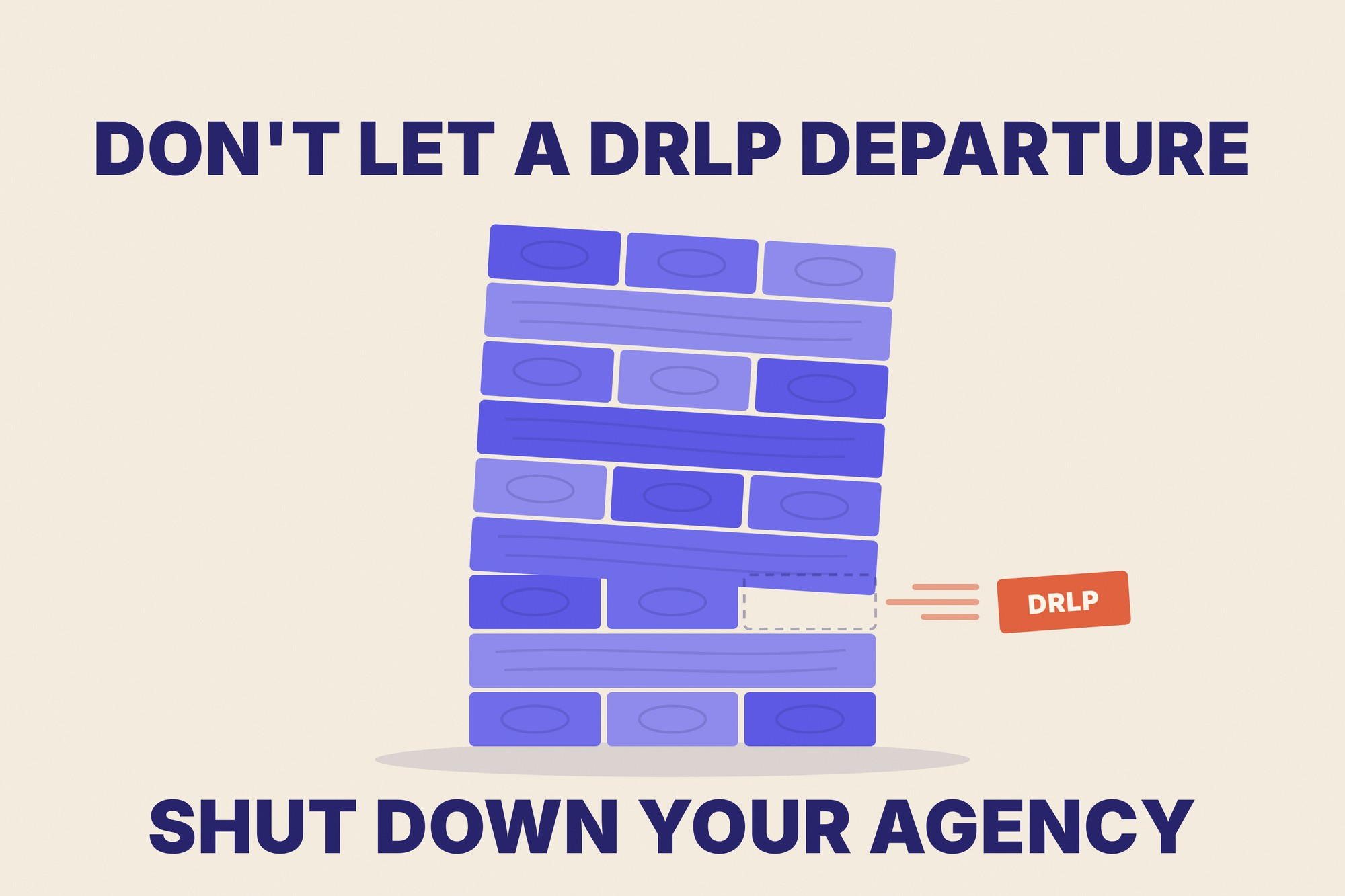
Your agency license is only as secure as the one person whose name sits in the DRLP field. If that person leaves, retires, or lets their license lapse, many states give you as little as 14 to 30 days to name a qualified replacement. Miss the window, and your entity license can be canceled.

That risk is getting more attention. Recent compliance guidance has named DRLP succession planning as a growing focus for state licensing departments. For banks, lenders, servicers, and fintechs selling embedded insurance, a DRLP gap is more than paperwork. It can stop revenue across every state you sell in.

What a DRLP is, and what happens when one leaves

A Designated Responsible Licensed Producer (DRLP) is the individual licensee a state holds accountable for a business entity's insurance compliance. Virtually every state requires agencies to name a DRLP or an equivalent, and in most states that person must hold an active individual license.

When the DRLP's status changes, the clock starts. Deadlines and penalties vary by state:

State

Window to replace the DRLP

What happens if you miss it

Washington

30 days

Entity license is canceled

Kansas

30 days

Entity falls out of compliance

Maine

14 days

Agency license is terminated

Michigan

14 days

Possible fine and license revocation

Vermont

None, prior notification is required

Agency license becomes invalid, must reapply

Delaware

None, prior notification or immediate update required

Agency license becomes invalid, must reapply


The damage rarely stops at the license. In some states a lapsed entity license ends its carrier appointments, and sometimes the appointments of downstream producers too. States that let multiple DRLPs split lines of authority, such as New Jersey, expect those DRLPs to cover every line together. If one leaves, or misses a license renewal the line they covered can be left exposed.

Multiply that across 51 jurisdictions and a single resignation becomes a multi-state compliance event.

Why an in-house successor is riskier than it looks

Naming a backup employee feels like a plan. For most financial institutions, it creates a second point of failure instead.

  • Turnover hits both people. Your DRLP and their backup often sit on the same team. A reorg, acquisition, or layoff can remove both at once.
  • Licensing is not their day job. An in-house successor must hold active resident and nonresident licenses, keep up with CE, and track renewals in every state. That work competes with their real role, and lapses happen quietly.
  • Every state works differently. Some states take changes online through NIPR, others by email or paper form with fees. Learning that under a 14-day deadline is how mistakes happen.
  • Lines of authority must match. In some states the DRLP must hold the lines your entity sells. A backup licensed for the wrong lines does not close the gap.
  • Real authority is expected. Regulators such as Washington's look for a DRLP with access to records, contracts, and supervisory authority. A junior employee chosen only to fill the field may not qualify.

The result is a plan that exists on paper but fails the moment it is needed.

Why partner with JLH Associates instead

JLH Associates specializes in insurance licensing for banks, lenders, servicers, and fintechs. We manage licensing in all 51 jurisdictions, so DRLP continuity is built into how we work, not bolted on after someone resigns. 

  • Continuity that doesn't depend on your org chart. Your DRLP coverage stays intact through promotions, departures, and reorganizations on your side.
  • Every state's rules, already mapped. We know which states give you 14 days, which give you 30, and which require the change before the DRLP leaves.
  • Lines of authority covered. We make sure your designated producers hold the lines your entity actually sells, so no line or carrier appointment is left exposed.
  • Proactive monitoring. We track licenses, renewals, and CE so a lapse is caught before a regulator catches it.
  • Zero internal lift. Your team keeps doing its job. You don't need to build or staff an internal licensing function.

The cost of a lapse is lost sales, re-filing fees, and broken carrier relationships. JLH turns DRLP succession from a recurring risk into a solved problem.

Five questions to ask about your DRLP plan today

  1. Who is your DRLP in each state, and is every one of their licenses active?
  2. If that person left tomorrow, who replaces them, and are they licensed in every state?
  3. Do your DRLPs, together, hold every line of authority your entity sells?
  4. Do you know each state's replacement deadline and filing method?
  5. Who is watching for lapses, renewals, and CE deadlines right now?

If any answer is "I'm not sure," your license is one resignation away from a gap. Contact JLH Associates to put a DRLP succession plan in place before you need it.

This article is general information, not legal advice. Confirm current requirements with each state's insurance department.

Sources


Speed to Coverage: Insurance That Won't Slow Your Closings Down

Speed to Coverage: Insurance That Won't Slow Your Closings Down

Speed to Coverage: Insurance That Won't Slow Your Closings Down

Read More
Does Your Bank Have an Operating Subsidiary- Licensed for Insurance?

Does Your Bank Have an Operating Subsidiary- Licensed for Insurance?

Learn how financial institutions in Michigan and nationwide are leveraging insurance subsidiaries to enhance revenue and customer experience without...
Read More
Knock Knock Knock...That's the Sound of the Regulator Coming Due to One Wrong License

Knock Knock Knock...That's the Sound of the Regulator Coming Due to One Wrong License

Knock Knock Knock...That's the Sound of the Regulator Coming Due to One Wrong License

Read More